
Swipe vs. Scroll: Which Digital Catalogue Format Wins?
When it comes to digital catalogues, how you present your products matters just as much as what you're selling. The choice between scrolling and page-turning directly shapes how customers process and retain information.


It's Not Just Aesthetics - It's Cognitive Science
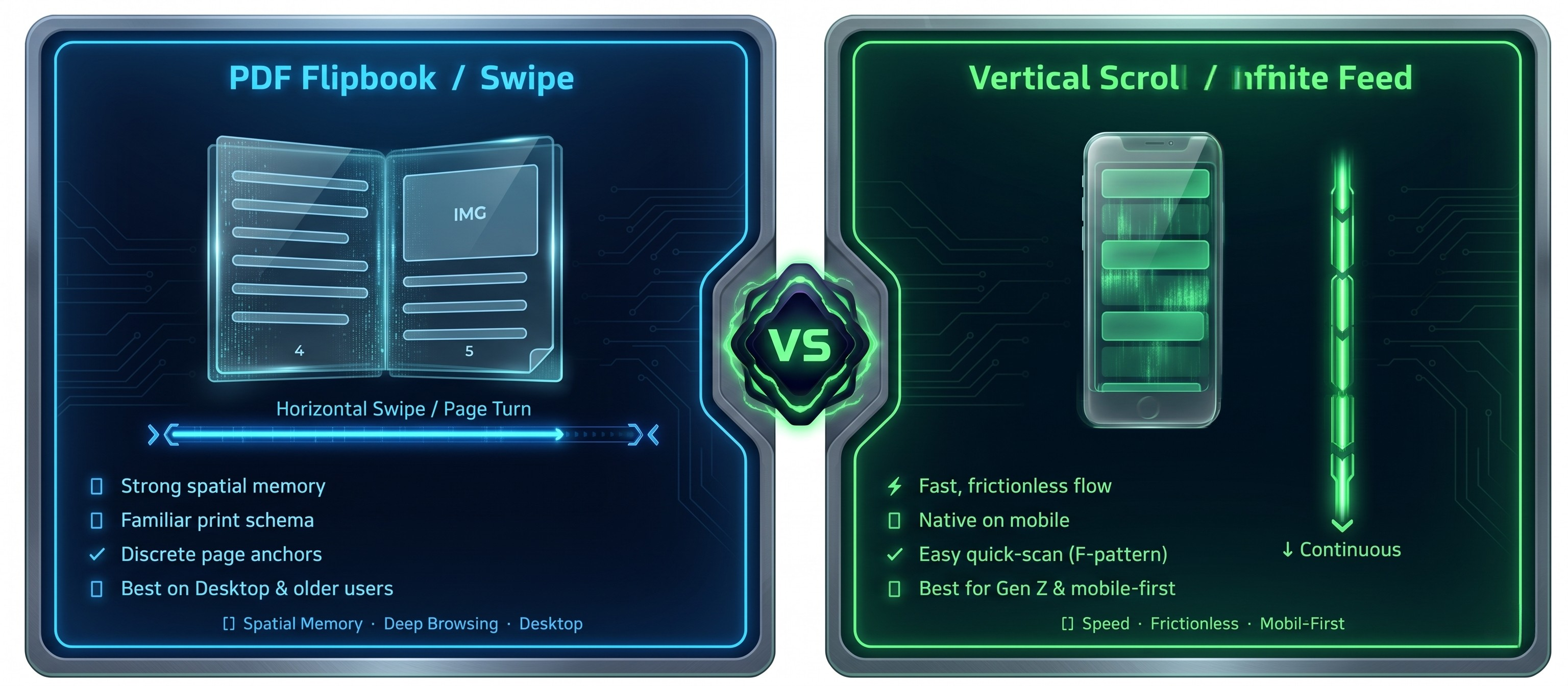
Vertical scrolling creates a continuous, unbroken stream of content, but it weakens spatial memory; users often can't recall where they saw something. PDF flipbooks, on the other hand, leverage a powerful psychological principle: each page spread becomes a distinct mental location.
The brain naturally maps information spatially, so "the red jacket was on the left page near the bottom" becomes a real memory anchor. This translates into better product recall and stronger engagement with catalogue content.
Desktop vs. Mobile: A Tale of Two Experiences
- On Desktop: Flipbooks tend to shine. Large screens support two-page spreads that preserve the original editorial layout, and keyboard or mouse navigation provides stability.
- On Mobile: The picture changes. Fixed-layout PDFs can become UX traps, forcing users to pinch and zoom. Bounce rates from non-responsive PDF formats are 40-50% higher on mobile.
Who Is Your Customer?
The study highlights a clear generational divide in how digital content is consumed:
- Baby Boomers & Gen X: Benefit significantly from flipbook-style catalogues. The page-turning interaction activates familiar mental models, reducing cognitive load.
- Gen Z: Expects speed and interactivity. For younger audiences, a fluid, swipe-based or scroll-based format consistently outperforms traditional layouts.
The Conversion Advantage of Modern HTML5
One of the most actionable findings concerns measurability. Traditional PDF catalogues are essentially a "black box" for marketers. Modern HTML5-based flipbooks change this entirely, enabling precise analytics on browsing behaviour, drop-off points, and product engagement.
The smartest strategy? Design for both, and let the data guide your next move. There's no universal winner—the right format depends on your audience and the device they're using.
