
The Tipping Point: The Final Years of the Analog Era
The Out-of-Home (OOH) advertising sector is undergoing a complete structural metamorphosis, transforming from static paper posters into a "connected canvas" powered by programmatic software and Artificial Intelligence (AI).
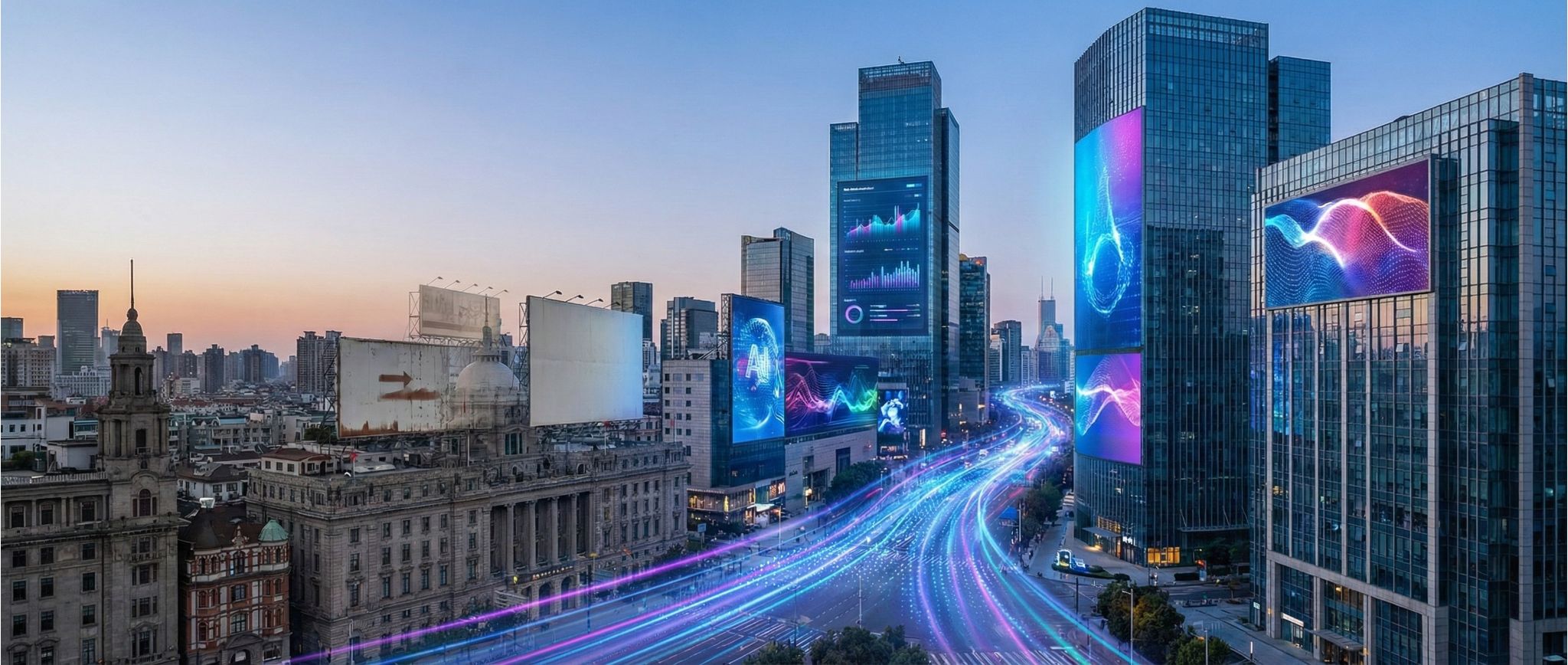
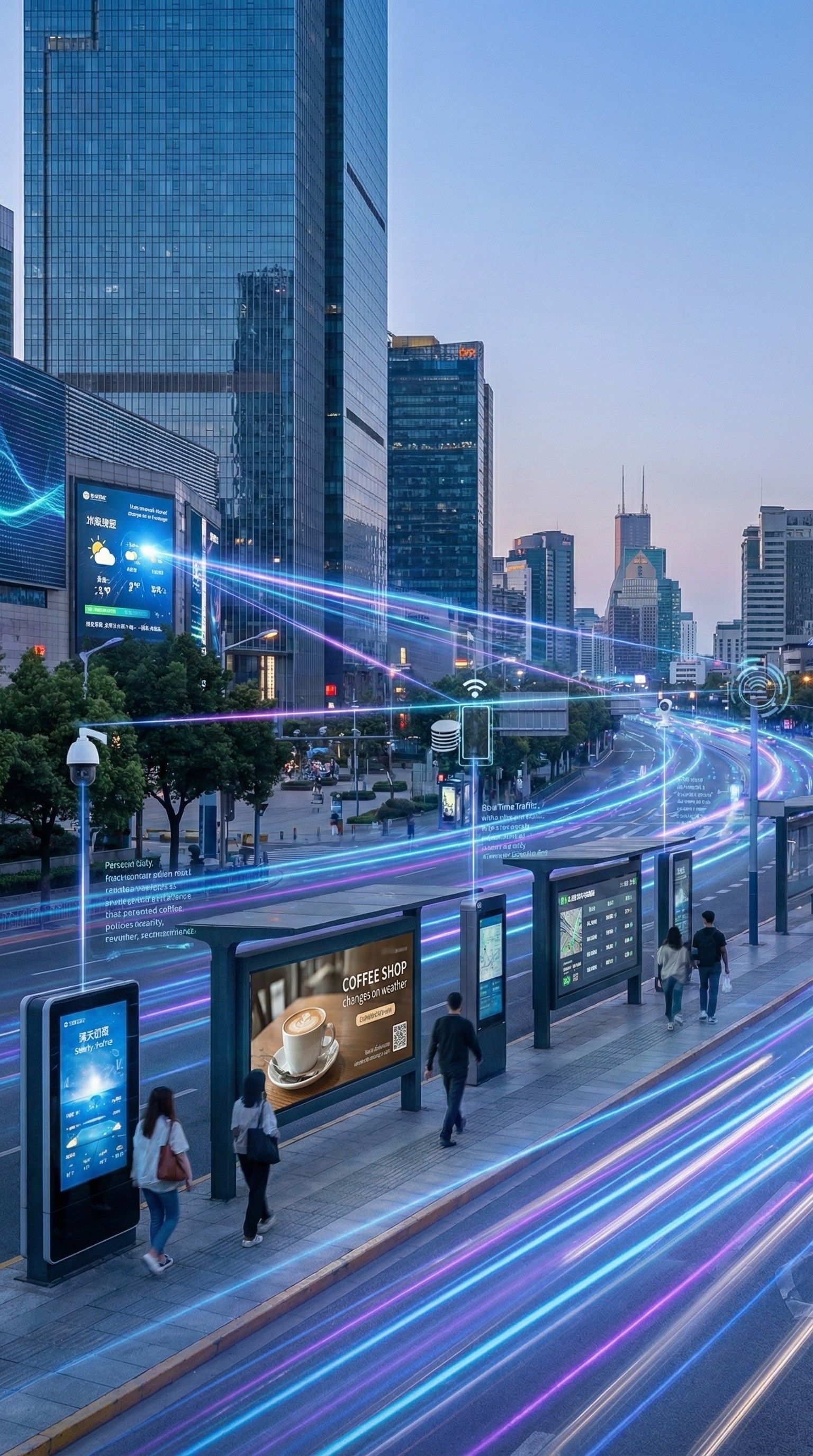
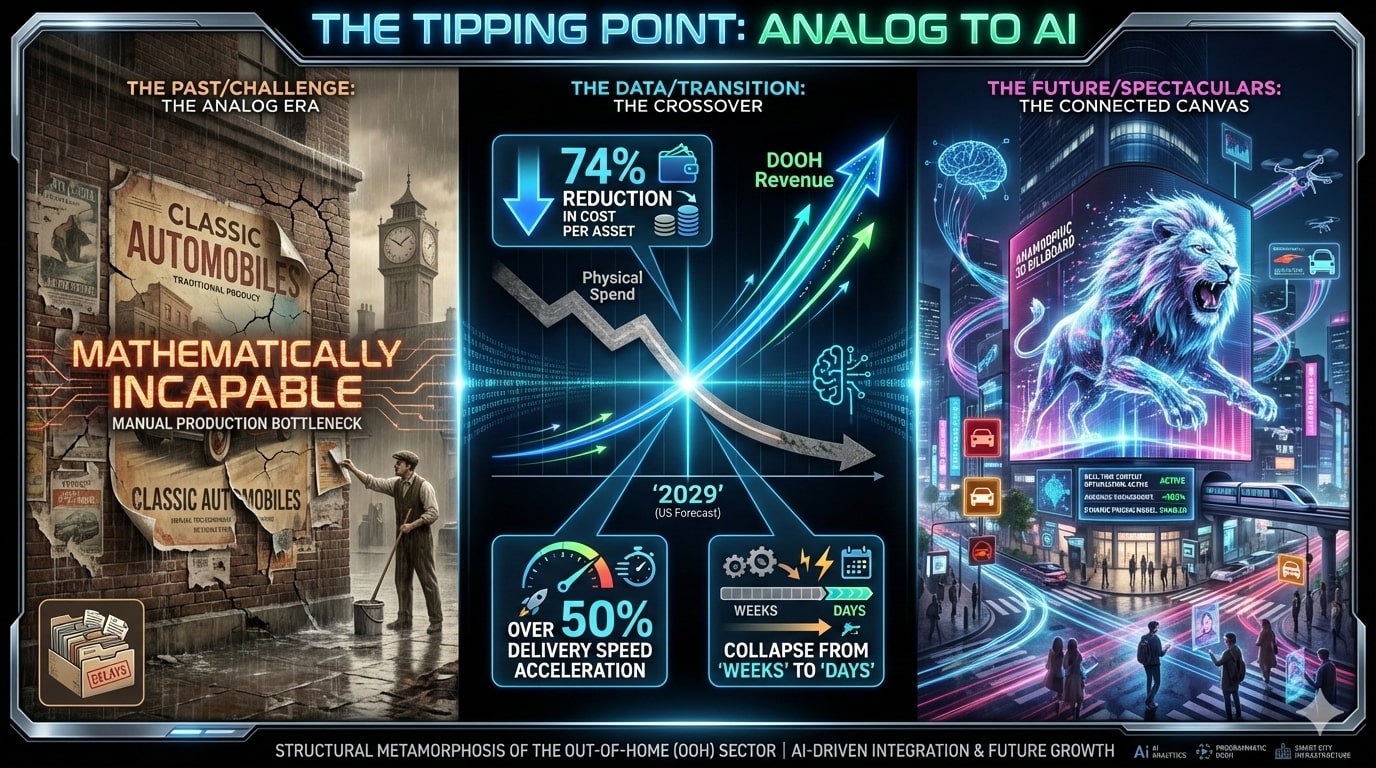
As Digital OOH (DOOH) revenue is forecast to surpass physical spend by 2029 in the US, the analogue era is definitively ending. The global leaders—media owners and agencies—are now leveraging this integration of software and hardware to solve the biggest modern challenge: producing hundreds of personalized, high-quality creative variants for the explosion of screens across the world.
The Game-Changing Strategy: Automation and Personalization
The core strategy driving OOH's resurgence is the seamless integration of AI into the creative production workflow, fundamentally changing the economic model of agency output. Traditional production methods are "mathematically incapable" of meeting the demand for endless variations—resized for different screens, localized for different cities, and optimized for different conditions—without relying on automation. The objective is to move beyond a single, static campaign and deliver hyper-personalized messages at scale.
Key Technological Pillars Driving Efficiency
The modern OOH campaign relies on a specialized toolkit that merges data and creative:
- Programmatic DOOH (pDOOH): This AdTech layer shifts buying logic from purchasing fixed spots to targeting a specific audience, using Real-Time Bidding (RTB). This allows advertisers to trigger ad plays based on real-time data signals like traffic, weather, mobile location, or even inventory availability. This brings the efficiency of digital display advertising to the physical world.
- Dynamic Creative Optimization (DCO): DCO is the engine of relevance, automatically changing creative copy, imagery, or pricing based on real-time triggers. For instance, showing a hot coffee ad on a rainy morning, and an iced drink ad when the sun comes out. A striking 95% of OOH professionals globally are interested in utilizing DCO.
- Generative AI for Production: Tools like Midjourney and DALL-E are used not just for ideation, but to automatically generate large volumes of background images, and quickly produce dozens of localized versions of an ad, significantly reducing the manual effort of resizing and re-rendering assets.
The Bottom Line: Efficiency and Speed
The impact of integrating AI-powered production workflows is dramatic, solving the "Asset Factory" crisis that plagues agencies. Case studies on early adoption show impressive gains by decoupling production cost from media volume:
- Up to 74% reduction in cost per asset.
- Over 50% acceleration in delivery speeds.
- Production timelines can be collapsed from weeks to days.
The Future is Now: Smart Cities and Spectaculars
The study notes that the most innovative OOH formats are emerging in highly integrated markets and premium locations. "Smart Cities," such as Shenzhen and Seoul, are integrating DOOH screens with public utilities like transport networks and environmental sensors. This enables screens to become part of the city's responsive systems, where advertising can be dynamically modified based on real-time city data like traffic congestion.
Simultaneously, high-impact campaigns leveraging anamorphic 3D billboards in hubs like London's Piccadilly Lights and New York's Times Square are pushing creative boundaries, requiring specialized 8K animation, 3D modelling, and perspective mapping to achieve stunning illusions that appear to leap out of the screen.
This convergence of programmatic buying, dynamic content, and AI-driven production is making OOH a powerful, measurable, and highly agile medium, fully competitive with digital-first channels.
