
Why Does It Work Exceptionally Well in the Sports and Leisure Sector?
Demand for sports and outdoor products is closely and directly correlated with current weather conditions. For Decathlon, this strategy is not merely a creative marketing gimmick, but a fundamental tool for understanding and serving consumer needs in real time.
The data clearly quantifies this business potential: During warm, sunny periods, bicycle sales can increase by as much as 20%. Each 1°C drop in temperature as cold weather sets in can result in more than 10% sales growth in the winter sportswear category.
International Case StudyIntroduction: Beyond the Pilot Campaign – Mapping the Strategic Opportunity
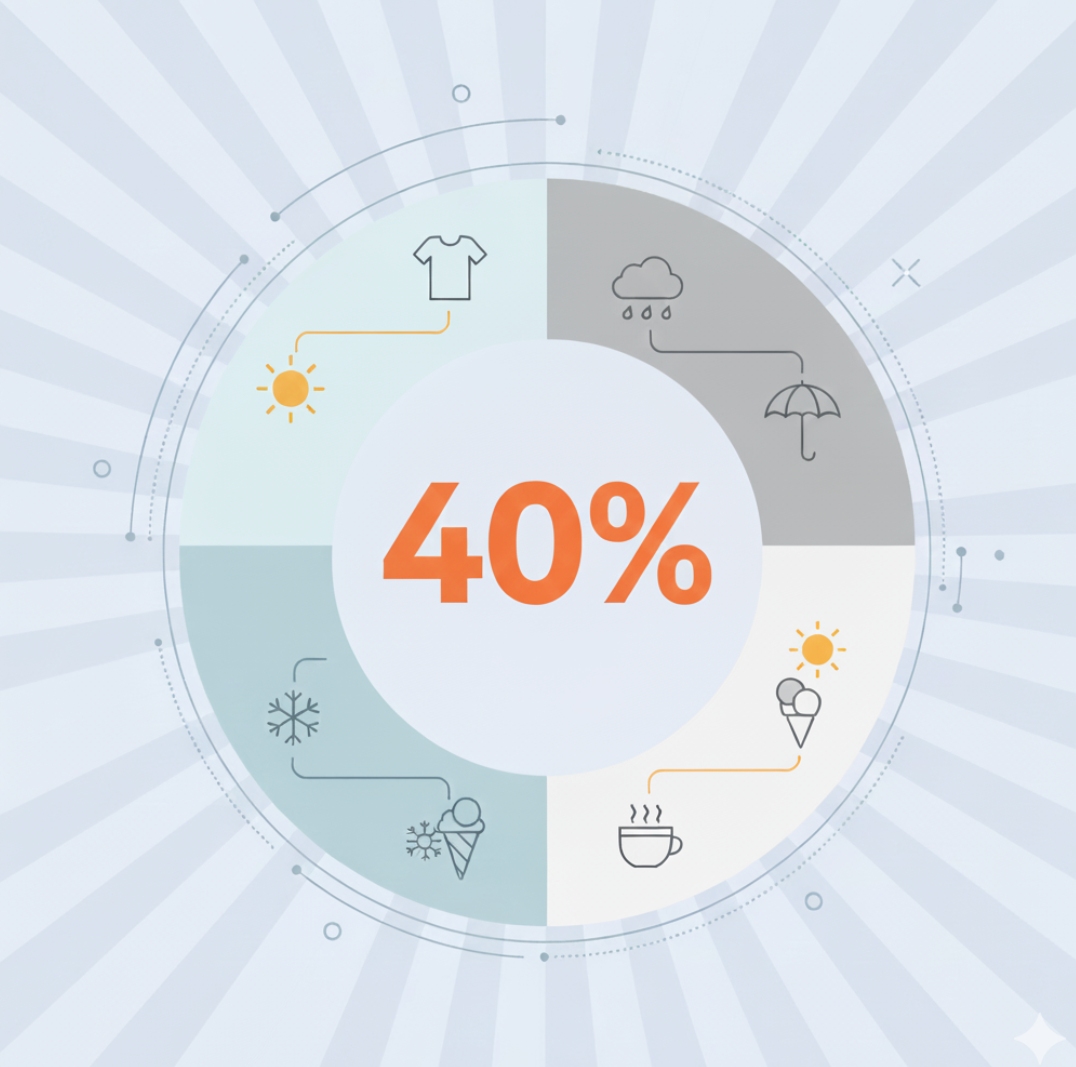
This document not only argues for continuation, but also outlines a detailed, data-driven plan for how Decathlon can gain sustainable competitive advantage in the domestic market, building on international experience and market conditions. The strategic importance of the topic is supported by research data showing that weather can explain up to 40% of daily retail traffic fluctuations. For Decathlon, this factor is not merely a marketing tool, but an opportunity for real-time and proactive service of consumer needs. In the sportswear and leisure sector, this relevance is particularly amplified, where purchasing decisions are fundamentally influenced by external conditions.
Instead of passively waiting for seasonal demand changes, we can proactively time our communication based on weather forecasts, reaching customers precisely when a given product is most relevant to them. This data is particularly valuable in the context of Decathlon's wide product portfolio. The company can proactively capitalize on these demand peaks by aligning digital ads and promotions with weather forecasts. A cycling campaign run before a sunny weekend, or ski equipment ads activated during the first snowfall, not only increase traffic but also strengthen the brand's relevance in consumers' eyes. As we will see in the next chapter, the international market has already proven the practical success of this theory.
International Success Stories: Proven Return on Investment (ROI) and Inspiration
Weather-based marketing is no longer a theoretical concept, but a tried and tested strategy that has brought measurable business results for numerous international brands. The successes achieved across various industries prove that contextual messages not only capture consumer attention more effectively, but also significantly improve return on advertising spend (ROI).
International Case Studies and Results
| Brand | Industry | Campaign Goal and Method | Measurable Results |
|---|---|---|---|
| Stella Artois | Cider brand | Temperature-triggered digital outdoor advertising (DOOH). | +65.6% sales increase, 50% fewer wasted ad impressions. |
| Molson Coors | Beer brand | Weather-based targeting on Facebook during sunny, warm weather. | +89% link clicks, 67% lower cost per click (CPC). |
| Pantene | Hair care | "Bad hair day" online coupon campaign run during high humidity. | +28% sales increase, 600,000 social media impressions. |
| Bravissimo | Lingerie/Swimwear | Google AdWords ads for bikini collection run only during sunny weather. | +600% revenue increase from search ads, +103% improvement in conversion rate. |
These case studies clearly demonstrate the versatility and power of the strategy. Weather-aligned marketing is simultaneously capable of increasing direct sales, improving advertising efficiency through cost optimization, and strengthening brand relevance. These international benchmarks offer not only inspiration but also a proven model that Decathlon can adapt in the domestic market for faster return on investment. The only question remaining is how we can also measure and prove these results during our own campaigns.
Measuring Success: KPIs and Methodologies for Reliable Results
Objective measurement of campaign success is essential for the long-term sustainability of the strategy and for gaining internal support. Selecting the appropriate measurement methodology depends on the campaign's primary objective: increasing brand awareness requires different key performance indicators (KPIs) than direct sales promotion.
4.1. Measuring Awareness Campaigns
For awareness-focused campaigns, the main goal is to increase emotional engagement and brand recall. When an ad perfectly matches the consumer's current context, the message creates a kind of "aha moment" that becomes much more deeply ingrained. The key metrics are as follows: Brand Lift Studies (Control group research that precisely measures the campaign's impact on brand awareness, brand favorability, and purchase intent), Brand Recall (Research shows that 90% of people remembered weather-activated ads, compared to 65% for generic messages. This metric directly validates the power of the cognitive "click" triggered by context.), Engagement/Interactions (The Molson Coors example also showed that relevant messages generate more comments, shares, and other social interactions, which indicate the level of consumer engagement.), and PR Value and Media Mentions (The "wow-factor" of a creative, weather-tied campaign has news value in itself and can generate organic press coverage).
4.2. Measuring Performance Campaigns
In this case, the focus is on direct and quantifiable business results, such as sales and conversion. Here, the campaign's success is validated by the hardest business metrics. The most important performance KPIs are: CTR (click-through rate), Conversion Rate (CR), CPA (cost per acquisition), Online/offline sales volume, and ROAS (return on ad spend). Two concrete international examples also support the positive impact on direct sales: French fashion retailer La Redoute achieved a 17% sales increase with its outdoor advertising, while Burger King increased product sales by 13% with a heatwave-responsive promotion. With knowledge of measurement goals and methodologies, we can now confidently plan the next phase of the strategy's expansion.
Strategic Recommendation for Expansion: Conquering the Domestic Market
Beyond international successes and available technology, the greatest strategic opportunity is provided by the local market environment. Based on desk research, the Hungarian market is underutilized in this area, creating a critical, time-sensitive opportunity (first-mover advantage) for Decathlon. With a well-executed, innovative weather-based campaign strategy, the brand can not only differentiate itself but also cement its role as market leader and innovator before competitors inevitably follow. This is not merely an opportunity, but a call to immediate action.
5.1. Recommended Channels and Objectives
For the strategy expansion, we recommend two main channels that serve different but complementary objectives: Digital Out-of-Home Advertising (DOOH) (An ideal tool for local, near-store awareness and activation campaigns. Digital billboards can respond to environmental changes in real-time, thus conveying highly relevant messages. For example, a billboard campaign advertising raincoats during a storm demonstrably generated 15% more sales for a sporting goods retailer.) and Social Media and Mobile Apps (These channels are most suitable for triggering impulsive, quick reactions. Users encounter the message on their personal devices, which enables direct call-to-action. The Waze navigation app example shows well that a location- and time-bound message (e.g., "Is it raining? Visit our nearby store!") can trigger immediate decisions.)
5.2. Fine-Tuning Targeting: Combining Multiple Triggers
The next level of increasing relevance is the intelligent combination of multiple data-driven triggers. With this method, we can create even more precise and personalized messages. It's important to note that, according to research, this type of environmental targeting does not elicit negative feelings from consumers, as it's based on contextual rather than personal data, thus representing an effective and "privacy-safe" solution. Two specific combination possibilities: Weather + Location (Enables hyperlocal messages. For example, we don't just advertise umbrellas when it's raining, but specifically target only those city districts where precipitation is occurring.) and Weather + Event (We outline the possibility along planned events (e.g., marathon) and spontaneous events (e.g., unexpected storm). For a marathon day, weather can fine-tune the communicated products (in sunshine: sunscreen and running shorts vs. in rain: waterproof running jacket). Additionally, it's worth developing an "emergency" scenario for spontaneous events, for example: "Storm approaching – here's the waterproof gear you'll need"). After outlining the strategy, the next step is to review the technological implementation and management of potential risks.
Implementation Framework: Technology and Risk Management
The technological foundation of the strategy is now fully mature and widely accessible. The key to success is not inventing new technologies, but selecting reliable partners, using accurate data, and careful planning. The most important elements of the technological infrastructure are as follows: Reliable Data Sources (Accurate and stable data provision is guaranteed by market-leading API providers such as >AccuWeather and IBM Weather Company. These provide real-time, hyperlocal data on which campaign automation can be built.), Integration Platforms (Middleware solutions like WeatherAds enable connecting advertising platforms to weather data sources without programming knowledge and creating automated rules for campaign activation.), and Costs and ROI (Technology costs (API and platform fees) are typically negligible compared to the total campaign budget. Through increased advertising efficiency, decreasing cost-per-click, and increasing conversion rates, these investments quickly pay off.).
Expert interviews identified two main challenges during implementation, for which proactive solutions must be developed: Challenge: Creative agility. Dynamic campaigns require multiple ad versions. Solution: Introducing more flexible creative production processes and pre-producing ad versions tailored to the most common weather scenarios (sunny, rainy, cold, warm). Challenge: Planning and monitoring complexity. Multi-variable campaigns require careful planning and supervision. Solution: It's advisable to plan campaigns with smaller, well-defined "what if" scenarios, and during the initial period, ensure dedicated attention to continuous monitoring and rapid intervention. With a solid framework in place, all that remains is to define the concrete next steps.
Summary and Recommended Next Steps
This report has clearly demonstrated that extending the weather-based marketing strategy is not merely a tactical opportunity, but a strategic necessity for Decathlon. The decision now is whether we proactively shape the future of domestic retail marketing as a market leader, or reactively follow our competitors. Our key arguments are as follows:
- The sports apparel sector and Decathlon's product range perfectly align with the logic of weather-based marketing, where demand is directly influenced by external conditions.
- The strategy's ROI has been proven internationally across numerous industries, and mature, objective methodologies are available for measuring success for both brand-building and performance-based objectives.
- The domestic market's lack of saturation offers Decathlon a unique and urgent opportunity to gain competitive advantage and strengthen its role as an innovator.
To successfully implement the strategy, we recommend the following concrete steps:
- Organize a joint workshop involving marketing and business areas (e.g., procurement, sales) to collaboratively define precise KPIs, objectives, and measurement methodology for the next campaign phase.
- Focusing on the next 3-6 months, select 2-3 key, highly weather-sensitive product categories (e.g., cycling, hiking, winter sports) on which the extended campaign can be built.
- Launch a larger-scale but still strictly measured campaign on selected channels (e.g., DOOH and Facebook) that incorporates learnings from the pilot and the international insights outlined in this document.
