
The Death of Manual Ad Versioning
If your team is still exporting spreadsheets, renaming files, and chasing approvals for every new ad version — you already know something is broken. The question is no longer whether manual ad versioning is inefficient. It's how much it's costing you.


A Process Built for a Different Era
Manual ad versioning made sense when campaigns ran across two or three placements. Today, a single campaign can require dozens of size variants, multiple language adaptations, audience-specific messaging, and real-time offers — all live simultaneously. The old process hasn't scaled. It has fractured.
The result is a familiar pattern: designers bottlenecked by repetitive resizing, marketers waiting days for simple copy changes, and ops teams firefighting version-control errors that only surface post-launch. Every wasted hour is a direct cost.
The Hidden Cost Nobody Tracks
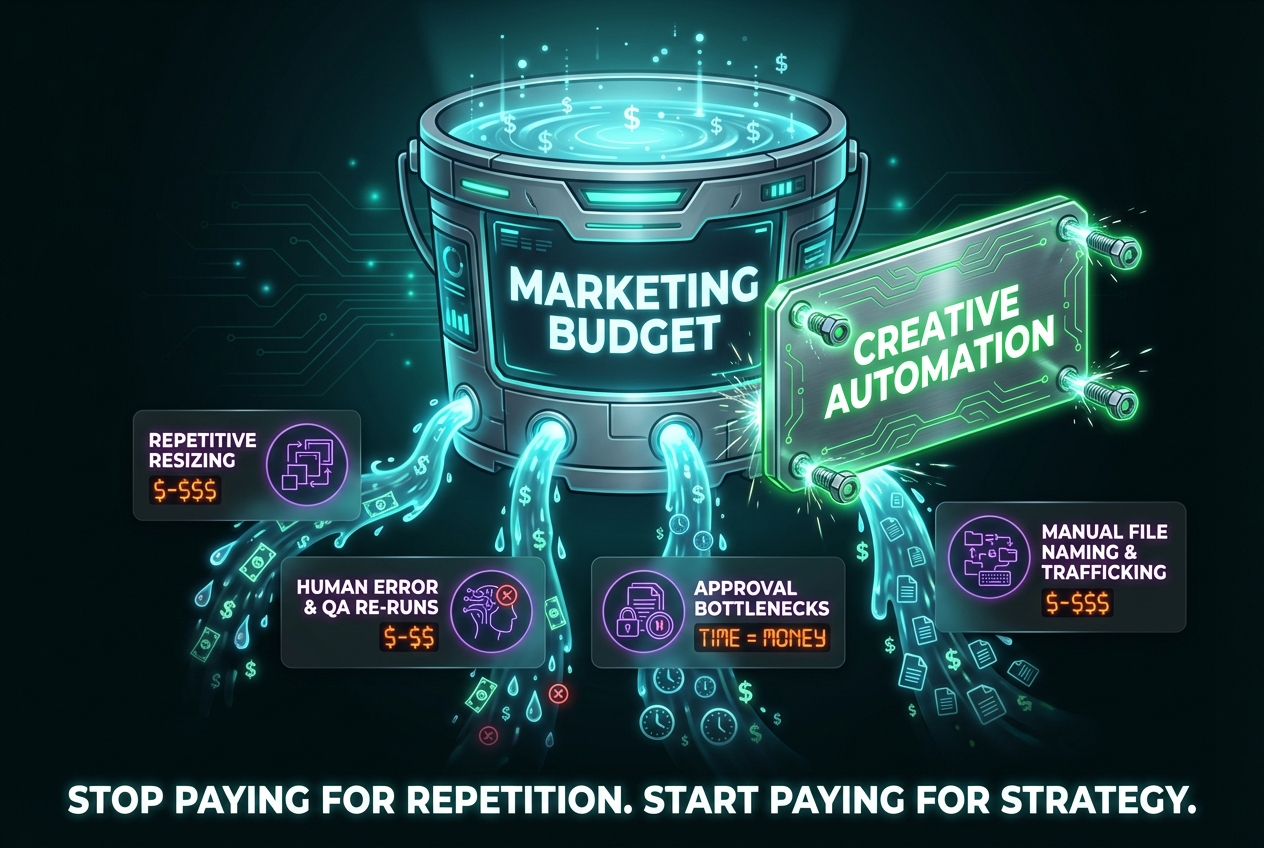
Most organisations track media spend with precision. Few track the internal cost of producing the ads themselves. When you account for designer hours, revision cycles, QA passes, and trafficking time, manual ad production is consistently one of the biggest unexamined drains in a marketing budget.
There's also the quality cost. When humans manage versioning at scale, mistakes happen. Wrong logos in localised markets. Outdated pricing in live creatives. Brand inconsistencies that slip through overloaded review workflows. These aren't edge cases — they're symptoms of a process under pressure.
What Modern Ad Ops Actually Looks Like
High-performing ad teams have moved away from file-by-file production toward template-driven, data-connected workflows. A single approved master template feeds multiple variants automatically — different sizes, different markets, different messages — without touching the design layer each time.
This is the foundation of dynamic creative optimization (DCO) and creative automation. It removes the bottleneck without removing creative control. Brand and legal guardrails are built into the template. What changes is the data, not the process.
The teams doing this aren't larger. They're faster. A campaign that previously took two weeks to version and traffic can go live in hours.
The Real Question
Manual versioning isn't dying because the industry decided to move on. It's dying because the scale of modern advertising has made it mathematically unsustainable. The teams still running it aren't behind on strategy — they're behind on infrastructure.
If your current workflow requires a human to touch every version of every ad, that's the constraint holding your output back. The solution isn't more headcount. It's a smarter system.
The teams winning on efficiency aren't doing more — they've replaced manual versioning with automated, template-driven production workflows, so they can focus on strategy, not repetition.
