
Cooking with AI: The Beginner’s Guide to DCO & Automation
By 2026, Artificial Intelligence has transitioned from a digital novelty to the core operating system of high-performing marketing teams. Yet, as AI becomes ubiquitous, a critical misunderstanding persists: the difference between Rule-Based Automation and AI-Driven Intelligence.
Watch the Video Summary
To understand and navigate this landscape, we must step out of the data center and into the kitchen. Success in 2026 requires knowing when to follow a rigid recipe and when to empower an Executive Chef.
Rule-Based Automation: The Reliable Recipe
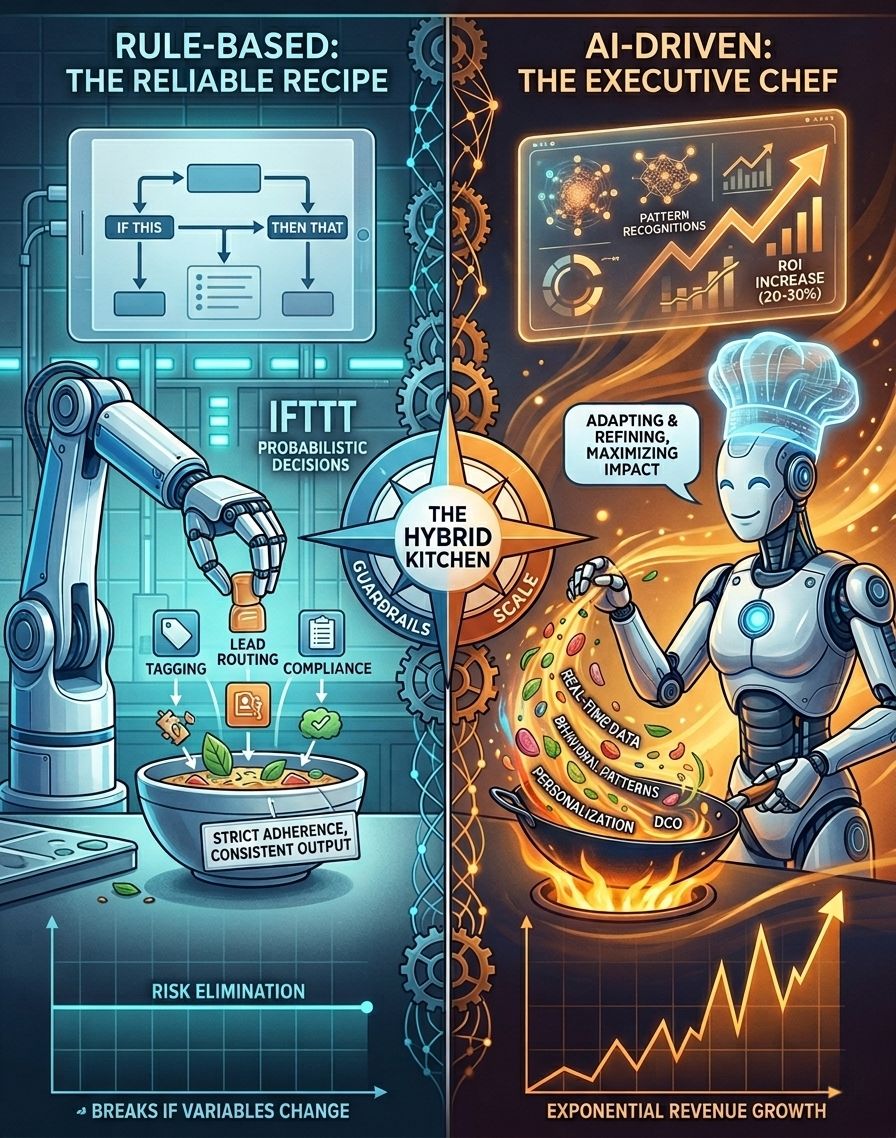
Rule-based automation is the traditional backbone of business workflows. It operates on deterministic logic—the classic "If This, Then That" (IFTTT) framework. When a specific trigger occurs, a predefined response follows. There is no interpretation, no nuance, and no deviation.
In our kitchen analogy, this is the recipe. If you have the exact ingredients and follow every step, you get a consistent result every time. This predictability is vital for maintaining compliance, as it ensures that data privacy and regulatory standards are met without fail. It also serves as the foundation for governance and accuracy, handling tasks like managing unsubscribes, SEO tagging, and basic lead routing.
However, 2026 has exposed the fragility of the "recipe" approach. While 42% of business tasks are now automated, rigid systems fail the moment variables change. If a kitchen runs out of eggs, the recipe doesn't improvise; it simply stops. Rule-based systems cannot adapt to unforeseen market shifts without manual human intervention.
AI-Driven Automation: The Executive Chef
If rules are the recipe, AI is the Executive Chef. Unlike static scripts, AI operates probabilistically. Using machine learning, it interprets patterns, assesses uncertainty, and makes informed decisions based on real-time, often incomplete, data.
A chef doesn’t just execute; they taste, adjust, and refine. They consider the diner’s history and the subtle quality of the ingredients. AI functions similarly:
- Continuous Learning: It optimizes output based on incoming behavior rather than fixed commands.
- Measurable Impact: Companies using AI-driven strategies report ROI increases of 20–30% and sales teams reclaim over two hours daily by offloading deep research.
- Revenue Generation: 65% of businesses now view AI as a primary revenue driver, with some seeing 300% returns through combined efficiency and cost savings.
The Hybrid Kitchen: Hyper-Automation
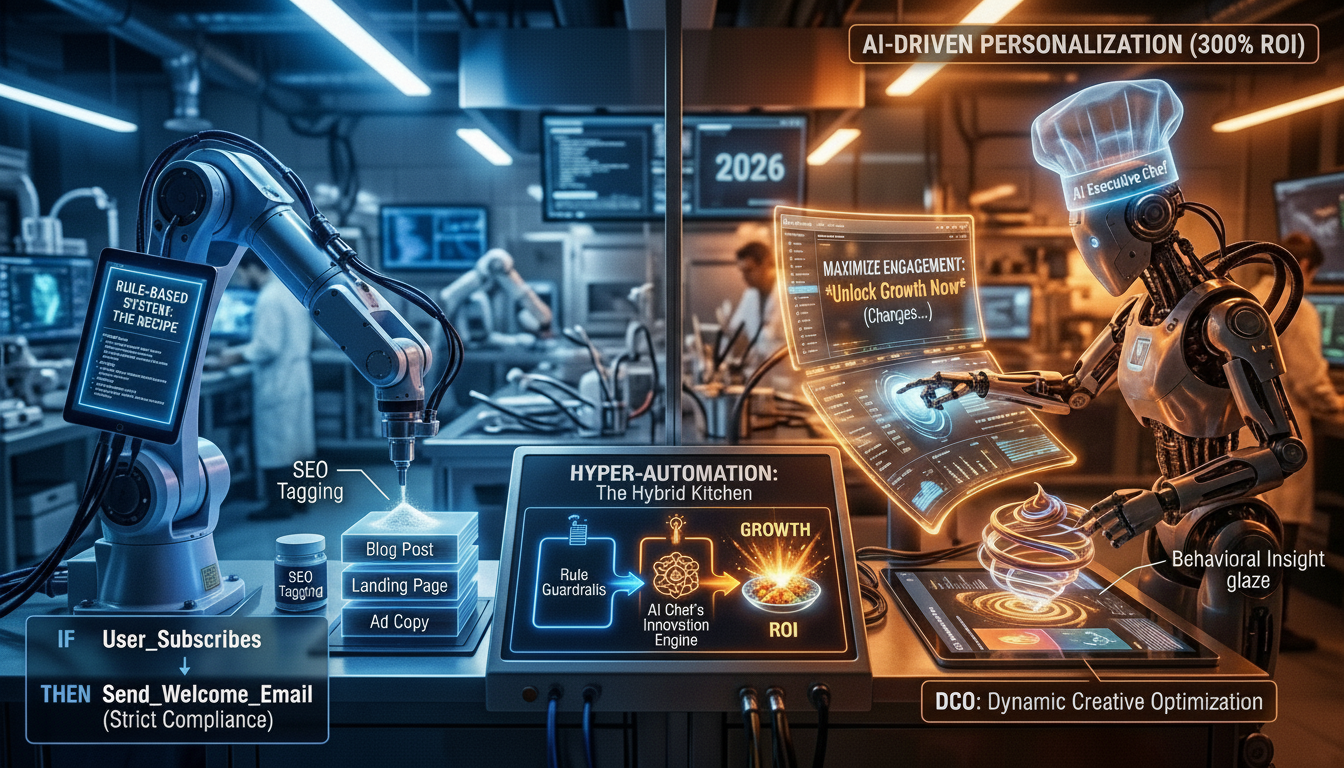
The winners in 2026 aren't choosing between recipes and chefs; they are building Hybrid Kitchens. This "hyper-automation" model integrates rule-based safeguards with AI-driven adaptability.
Rules provide the guardrails. They ensure the "chef" stays within brand guidelines and legal privacy requirements. AI provides the scale. It detects subtle behavioral shifts and personalizes customer experiences at a volume no human team could ever manage. Where rules ensure control, AI enables exponential growth.
Conclusion: Strategy Over Tools
In a world where 88% of businesses use AI regularly, the competitive edge is no longer the technology itself, but the strategy of organization. It is about knowing when to rely on the precision of a rule and when to let the AI chef innovate.
Don't let your marketing strategy go cold. Whether you need a foolproof recipe or a master chef to lead your data-driven campaigns, the right balance is the only way to stay competitive.
Ready to upgrade your marketing kitchen? Book a Discovery Call with POMS today for a custom Automation Audit.
