
AI Regulation in the US: Flexible, Fragmented, Fast
The United States is not regulating AI less — it is regulating it differently.
While Europe is building a centralized AI framework, the US is prioritizing flexibility and innovation. There is no single federal AI law, and that is not an accident: the American model is built around speed, competitiveness, and the belief that regulation should not slow down technological progress too early. In the US, speed and competitiveness often take priority over centralized regulation. That makes the system more adaptable, but also more complex for businesses trying to understand what actually applies.
What is the US approach to AI regulation?
The United States uses a decentralized approach to AI governance rather than a dedicated national AI statute. Instead of one comprehensive legal framework, AI is regulated through a patchwork of existing institutions, executive orders, agency guidance, and sector-specific rules.
That means AI regulation in the US is less about a single law and more about how existing laws are applied to AI use cases. The US regulates AI through a patchwork of existing institutions rather than a single dedicated framework.
Why the US chose a flexible model
The American model is driven by a clear philosophy: regulation should protect the public without slowing innovation. Policymakers have been cautious about regulating too early because they fear that overly rigid rules could weaken the country’s competitive position in a fast-moving global market.
That concern is closely tied to competition with China, the dominance of major technology companies, and the need to support the startup ecosystem. The US sees AI as both an economic opportunity and a strategic asset. The American model prioritizes adaptability over uniformity.
US policymakers are cautious about regulating too early, especially when the technology and its business applications are still evolving rapidly.
How AI regulation works in practice
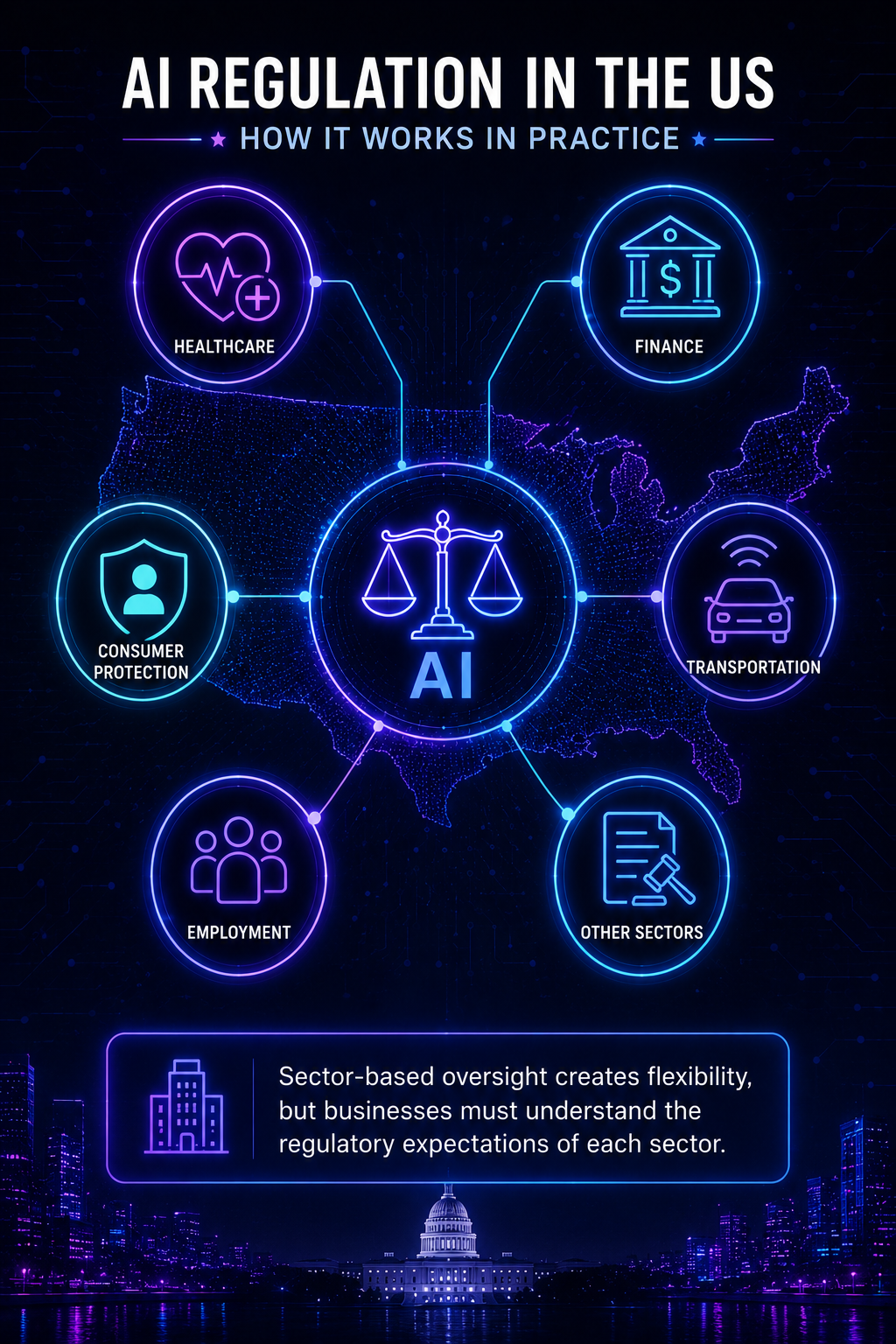
In practice, AI regulation in the US depends heavily on the sector in which the technology is used. Different agencies apply different rules, which means the regulatory picture is shaped by the context rather than by one universal standard.
- Healthcare: AI tools may fall under FDA oversight when they affect diagnosis, treatment, or clinical decision-making.
- Finance: AI systems may be reviewed under consumer protection, fair lending, and market integrity rules.
- Consumer protection: The FTC and similar bodies may act against deceptive, unfair, or harmful AI practices.
- Transportation: Autonomous driving and mobility systems can face safety-based oversight.
- Employment: Hiring algorithms and workplace AI tools may trigger anti-discrimination and labor-related review.
This approach creates flexibility, but it also means businesses must understand the regulatory expectations of each sector individually.
Federal vs state-level regulation
One of the defining features of the US model is the lack of a fully unified national system. Federal agencies are active, but so are state governments, and that makes compliance more complicated over time.
In recent years, state-level AI rules have expanded, especially in areas like employment, consumer protection, privacy, and algorithmic accountability. For businesses, the biggest challenge is often inconsistency rather than restriction.
That is a key feature of AI governance in the US: companies may be allowed to launch quickly, but they must still manage a growing patchwork of local and sector-specific rules.
Strengths and weaknesses of the US model
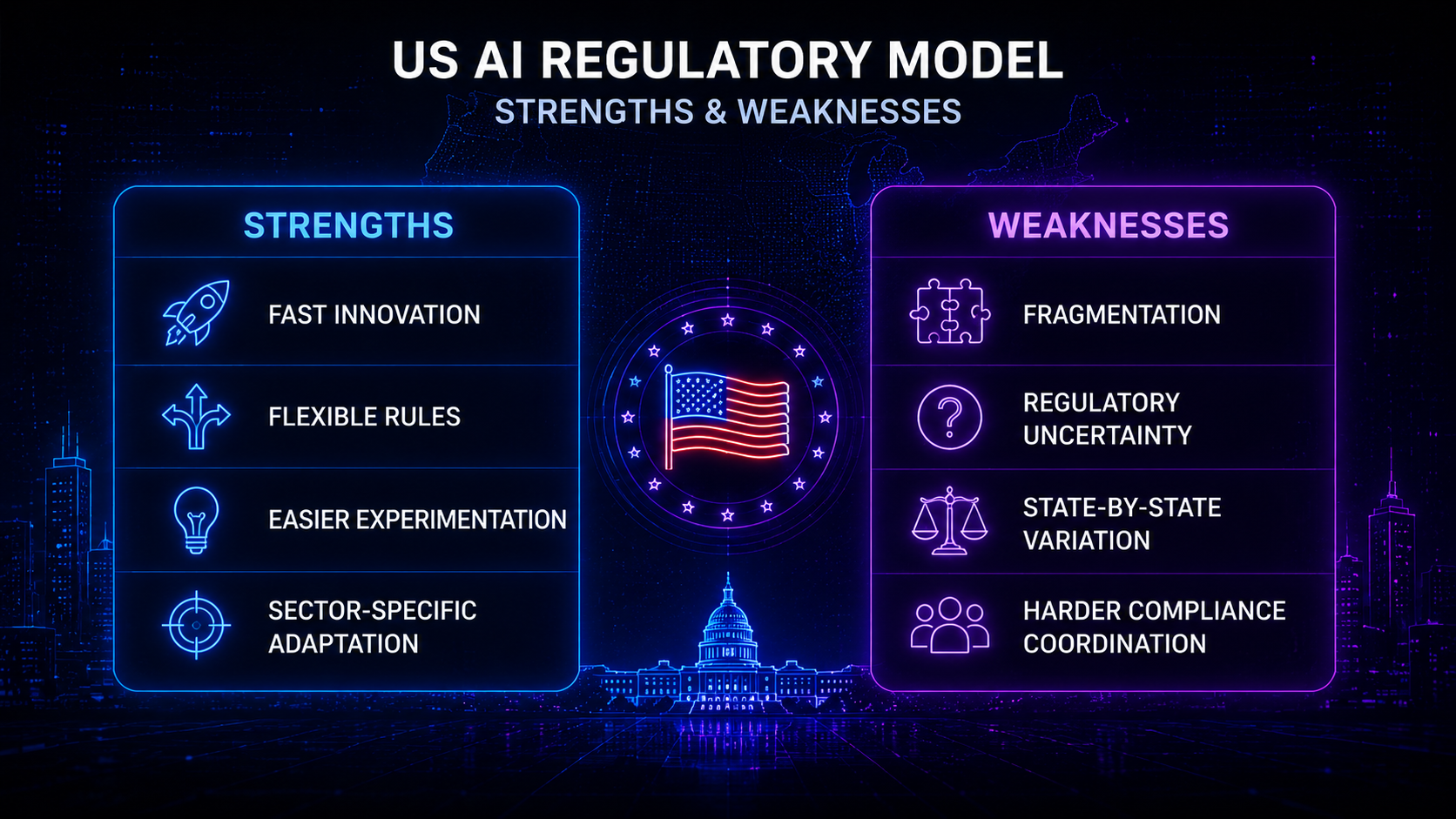
This is why the US model is attractive to startups and large technology companies, but more difficult for compliance teams that need predictable obligations. It supports rapid testing and deployment, but it can also create legal ambiguity.
US vs EU approach
The difference between the US and EU is mostly philosophical.
The EU is building a centralized, risk-based framework with a strong focus on rights, accountability, and harmonized obligations. The US, by contrast, uses a decentralized, market-driven model that gives more room for industry adaptation and faster deployment.
👉 Read our full EU vs US vs China comparison
What this means for companies
For companies, the US can be a relatively easier market to enter quickly, but a harder one to manage consistently. The absence of a single rulebook means businesses must track multiple legal layers at once and adapt to sector-specific expectations.
In the US, businesses often navigate regulation industry by industry rather than through a single rulebook. That makes internal governance, legal monitoring, and cross-functional coordination especially important.
Conclusion: The US approach to AI regulation reflects a broader belief that innovation should not be constrained too early. Rather than creating one centralized legal framework, America is allowing AI governance to evolve through existing institutions, sectoral rules, and market realities. America’s AI strategy prioritizes speed, flexibility, and technological leadership — even at the cost of regulatory consistency.
