
AI compliance as a business challenge
Managing AI compliance in one country is difficult. Managing it across multiple regulatory systems is becoming a strategic challenge. As organizations adopt AI at scale, they are no longer dealing with one legal environment, but with a fragmented landscape where the same system may need different controls depending on where it is deployed and how it is used.


This matters because global AI governance is becoming an operational problem, not just a legal one. Companies now need governance models that can handle changing rules, multiple jurisdictions, vendor complexity, and continuous monitoring at the same time.
Why AI compliance is getting harder
The biggest reason AI compliance is getting harder is that the same AI system may be treated differently across regions. One country may focus on transparency, another on risk classification, and another on sector-specific obligations or consumer protection.
Companies also have to manage multiple jurisdictions at once, often while regulations are still changing. Add in the complexity of third-party vendors, cloud providers, model providers, and embedded AI features, and compliance becomes a moving target rather than a static checklist.
The core principles of a global AI governance strategy
Central governance, local adaptation
The most effective AI governance models combine centralized oversight with regional flexibility. Organizations should define global AI standards while allowing local teams to adapt them to jurisdiction-specific requirements. This creates consistency across markets without ignoring local regulations.
Risk-based governance
Not every AI system creates the same level of risk. High-impact systems require stricter oversight, stronger controls, and more documentation than lower-risk tools. A risk-based approach makes AI compliance more practical and scalable.
Documentation and transparency
Organizations need clear records of how AI systems are built, trained, and used. Transparency also means being able to explain how systems work, where they are used, and when human review is involved. Without this, compliance becomes difficult to demonstrate.
Human oversight
AI systems still require human accountability. Companies need clear review processes, escalation paths, and defined ownership for monitoring AI decisions and handling failures or unexpected behavior.
Vendor and third-party governance
Many companies rely on external AI providers, which makes vendor oversight essential. AI compliance should include due diligence, procurement controls, contract review, and ongoing monitoring of third-party systems.
Building an AI governance operating model
An AI governance operating model works best when responsibility is structured across three layers. At the top is leadership, which sets policy, risk appetite, and accountability. In the middle is the governance process, where legal, compliance, security, and product teams coordinate decisions. At the operational level are the inventory, monitoring, approval, and testing controls that keep AI systems under review.
This structure is useful because AI compliance cannot sit in one department alone. Legal teams may understand the rules, but product, engineering, procurement, and security teams are the ones who implement them in practice.
AI compliance checklist
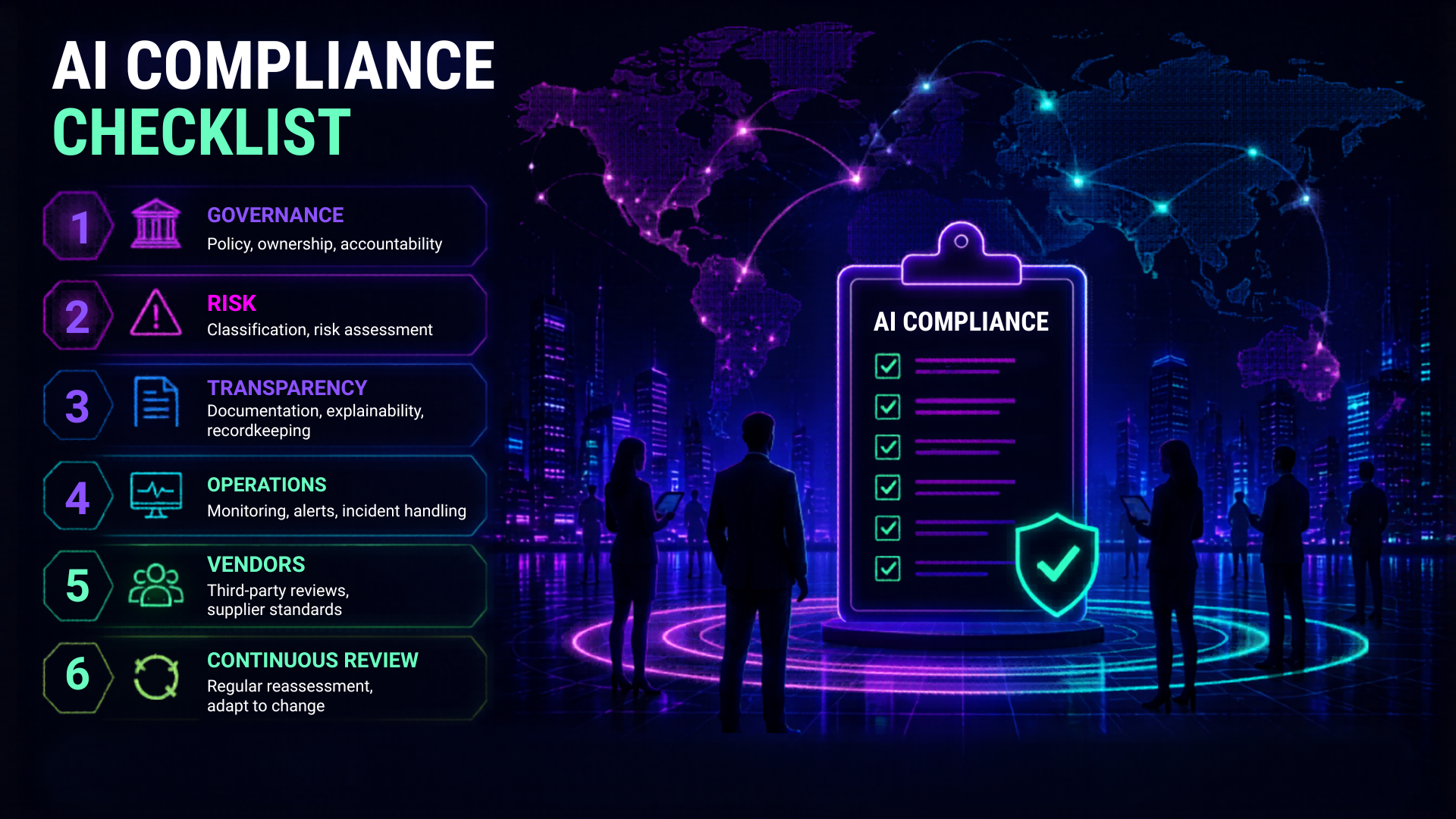
A practical AI compliance checklist should cover at least six areas:
- Governance: AI policy, ownership structure, and accountability.
- Risk: System classification and formal risk assessment.
- Transparency: Documentation, explainability, and recordkeeping.
- Operations: Monitoring, alerts, and incident handling.
- Vendors: Third-party reviews and supplier standards.
- Continuous review: Regular reassessment as regulations and systems change.
This checklist works best when it is treated as an operating baseline rather than a one-time project. AI compliance is not static, so the controls must evolve with the system and the regulation around it.
Common mistakes companies make
One of the most common mistakes is treating AI compliance as only a legal issue. In reality, it is a cross-functional governance issue that affects product design, procurement, data management, and security as much as law and policy.
Another mistake is ignoring vendors. Companies often assume that if a tool is outsourced, the compliance risk is outsourced too, but that is rarely true. Poor oversight of third-party AI providers can create the same regulatory exposure as building the system internally.
A third problem is reactive governance. Many organizations try to solve compliance only after deployment, when the cost of change is already high. The biggest AI compliance risk is often organizational fragmentation.
What the future looks like
The future of AI compliance is likely to be more operational, more automated, and more international. Companies are increasingly moving toward governance automation, AI audits, continuous monitoring, and compliance tooling that can support multiple frameworks at once.
Over time, international interoperability will become more important. Businesses operating globally will not be able to rely on one national standard alone, so governance systems will need to support several regulatory regimes at the same time. Companies that operationalize AI governance early will scale faster across regions.
AI compliance is becoming part of digital infrastructure, not just regulatory administration. As regulation fragments and AI adoption expands, the companies that succeed will be the ones that build governance into the way they design, buy, deploy, and monitor AI.
In a fragmented regulatory world, scalable AI governance may become a competitive advantage. Organizations that establish strong oversight, documentation, risk management, and vendor controls now will be better positioned to grow safely across markets later.
