
The rise of hybrid AI regulation models
Artificial intelligence is advancing faster than the legal systems designed to govern it. As a result, many countries are no longer choosing between a fully centralized AI law and a completely sector-by-sector approach. Instead, they are building hybrid models that combine elements of both.
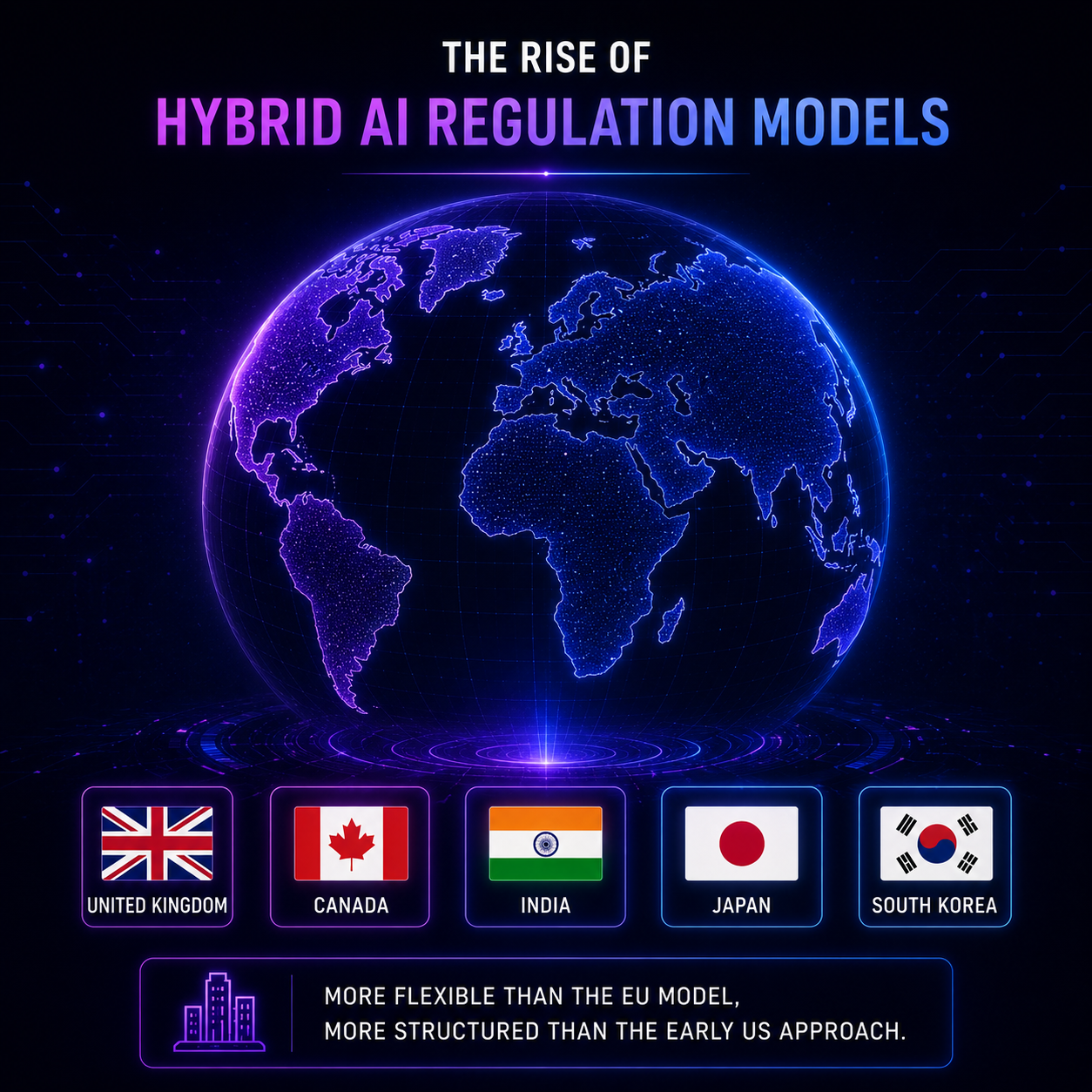
This middle path is becoming increasingly common in the UK, Canada, India, Japan, and South Korea. Each of these countries is trying to balance two goals at once: encouraging innovation and managing risk. The result is a regulatory landscape that is more flexible than the EU model, but more structured than the early US approach.
United Kingdom
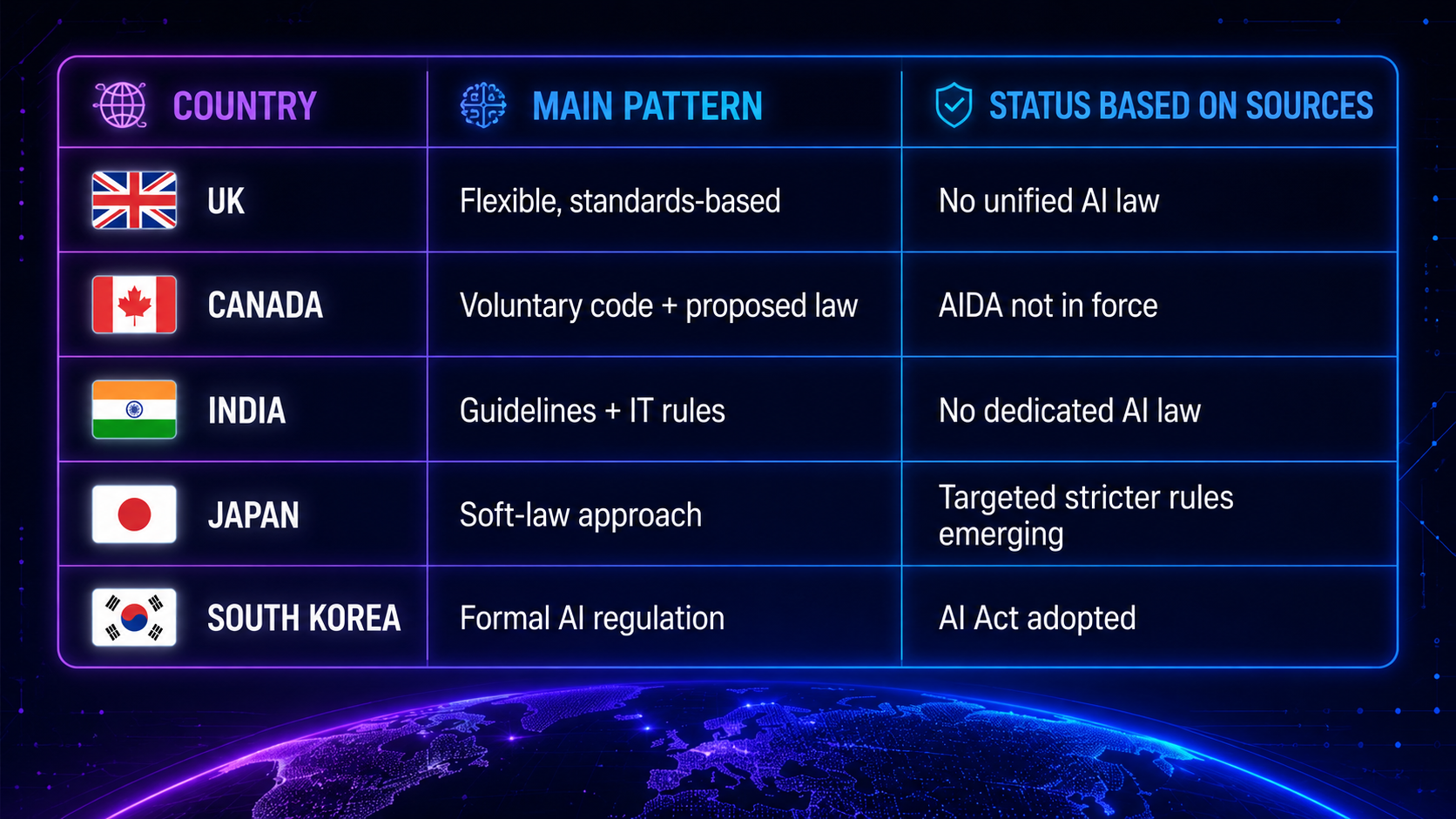
The UK has taken a relatively flexible path. Rather than introducing one broad AI law, it has relied on existing regulators, policy guidance, and standards-based governance. The emphasis is on how AI is deployed, tested, and monitored, rather than on imposing one single legal framework across the entire economy.
This approach allows the UK to move quickly and adapt to technological change. It also gives regulators room to respond to specific risks in different sectors without freezing innovation too early. At the same time, the UK is increasingly focusing on AI safety, model evaluation, and practical standards for responsible deployment.
Canada
Canada is moving toward a more formal AI framework, but it has not yet built a fully operational AI law. Instead, the country is using a mix of proposed legislation, voluntary commitments, and existing sector rules. This makes its model hybrid by nature.
The Canadian approach shows a preference for flexibility and risk sensitivity. Rather than regulating every AI use case in the same way, the proposed framework would distinguish between different levels of impact. In the meantime, voluntary codes and existing legal instruments continue to shape how AI is developed and used.
India
India does not currently have a single dedicated AI law. Instead, it relies on principles, digital governance rules, and sector-specific initiatives. AI is being addressed through broader technology policy rather than through a standalone legal code.
This creates a model that is both cautious and pragmatic. India is clearly interested in AI governance, but it appears to prefer gradual development over immediate heavy regulation. The country is combining soft guidance, updated digital rules, and sectoral oversight to manage AI-related issues as they arise.
Japan
Japan is another example of a hybrid approach. It has generally favored soft-law governance, meaning that guidance, standards, and non-binding frameworks play an important role. At the same time, there is movement toward stronger legal measures for certain risks.
This gives Japan a balanced position. It is not rushing toward a fully rigid AI regime, but it is also not relying only on voluntary principles. Instead, it is layering policy tools in a way that preserves flexibility while allowing for more targeted legal intervention where needed.
South Korea
South Korea stands out as one of the more advanced hybrid models. It has moved further toward a formal AI law, while still keeping broader governance and safety considerations in view. This makes it more structured than some other Asian markets, but still different from the EU’s fully centralized model.
South Korea’s approach reflects a clear interest in creating legal certainty without losing innovation momentum. It combines legislation with broader policy coordination and technical oversight, which makes it a strong example of a hybrid system in practice.
What these models have in common
Although these countries are moving at different speeds, they share a similar logic. None of them is fully copying the EU or fully adopting the US model. Instead, they are mixing legal tools to fit their own political, economic, and technological priorities. That usually means a combination of:
- Existing sector laws.
- Soft-law guidance.
- Targeted AI-specific rules.
- Risk-based obligations for sensitive use cases.
- Ongoing regulatory experimentation.
This is why hybrid regulation is becoming such an important concept. It reflects the reality that AI is too broad and too fast-moving to fit neatly into one legal box.
Why this matters for businesses
For companies, hybrid regulation creates both opportunity and complexity. On the one hand, it often leaves room for innovation and product development. On the one hand, it means compliance is not uniform across countries, and sometimes not even uniform across sectors within the same country.
Businesses that operate internationally need to understand not only whether AI is regulated, but how it is regulated. A product that is acceptable under one jurisdiction’s guidance may trigger formal obligations in another. That makes legal monitoring, governance, and product planning essential.
The bigger picture
The rise of hybrid AI regulation shows that the global conversation is moving beyond a simple “regulate or not regulate” question. Countries increasingly want to manage AI through systems that are flexible, adaptive, and tailored to local priorities.
In practice, that means the future of AI governance will likely be shaped by mixed models rather than one universal rulebook. For businesses, the key challenge will be to build AI strategies that can work across different legal environments without losing speed or control.
