AI Regulation in China: Control, Compliance, and Content Governance
This briefing document provides a deep-dive analysis of the Chinese model of Artificial Intelligence regulation, contrasting it with the European and American frameworks. The Chinese approach is characterized by a unique synthesis of aggressive technological investment, proactive legal adaptation, and strict state-led oversight aimed at maintaining national security and ideological alignment.

1. Strategic Philosophy: State Control and Security
China’s approach to AI is fundamentally defined as a "State control and security-focused approach." While the nation is striving for global leadership in AI through massive state and corporate investments, this development is kept under tight supervision. The primary objective is to balance rapid technological advancement with the preservation of state authority and national security.
Core Pillars of the Chinese Model:
- Proactive Legal Response: Unlike some jurisdictions that have been slow to adapt, Chinese legal practice has reacted quickly to the challenges posed by AI.
- Ideological Alignment: AI systems are not merely technical tools but are required to operate within the ideological framework of the state.
- National Security Integration: Technological development is treated as a component of national security, requiring continuous monitoring and state-level oversight.
2. Governance Mechanisms and Content Control
The regulatory landscape in China is characterized by centralized oversight and specific mandates regarding the output of generative AI models. The Cyberspace Administration of China (CAC) serves as the primary regulatory body. It has implemented a strict algorithmic registration system, requiring developers to register their models and provide transparency regarding the underlying logic of their AI systems.
China’s regulation of generative AI is heavily focused on content governance. The CAC mandates that AI-generated content must adhere to specific ideological and legal standards:
- Socialist Core Values: All generative AI models must produce content that reflects "socialist core values."
- State Power Preservation: The production of content that subverts state power or undermines the existing political system is strictly prohibited.
- Compliance Responsibility: Model providers are held accountable for the outputs of their systems, ensuring they do not facilitate "system-subverting" content.
3. Intellectual Property and AI-Generated Content
In a notable departure from the legal trends seen in the United States, China has shown a greater willingness to extend copyright protections to AI-assisted creations under specific circumstances. Beijing courts have established precedents that differ from American practices:
- The "Human Input" Standard: In some cases, Chinese courts have recognized copyright for AI-generated images, provided there is evidence of "adequate human input and selection" in the creative process.
- Entity-Linked Rights: This recognized copyright is often tied specifically to citizens or legal entities.
- Comparison with the US: While the US Copyright Office generally denies protection to content generated autonomously by AI (due to a lack of "minimal human creativity"), Chinese courts have demonstrated a more flexible, pro-innovation stance on AI-generated assets when human oversight is demonstrable.
4. China in the Global Regulatory Landscape
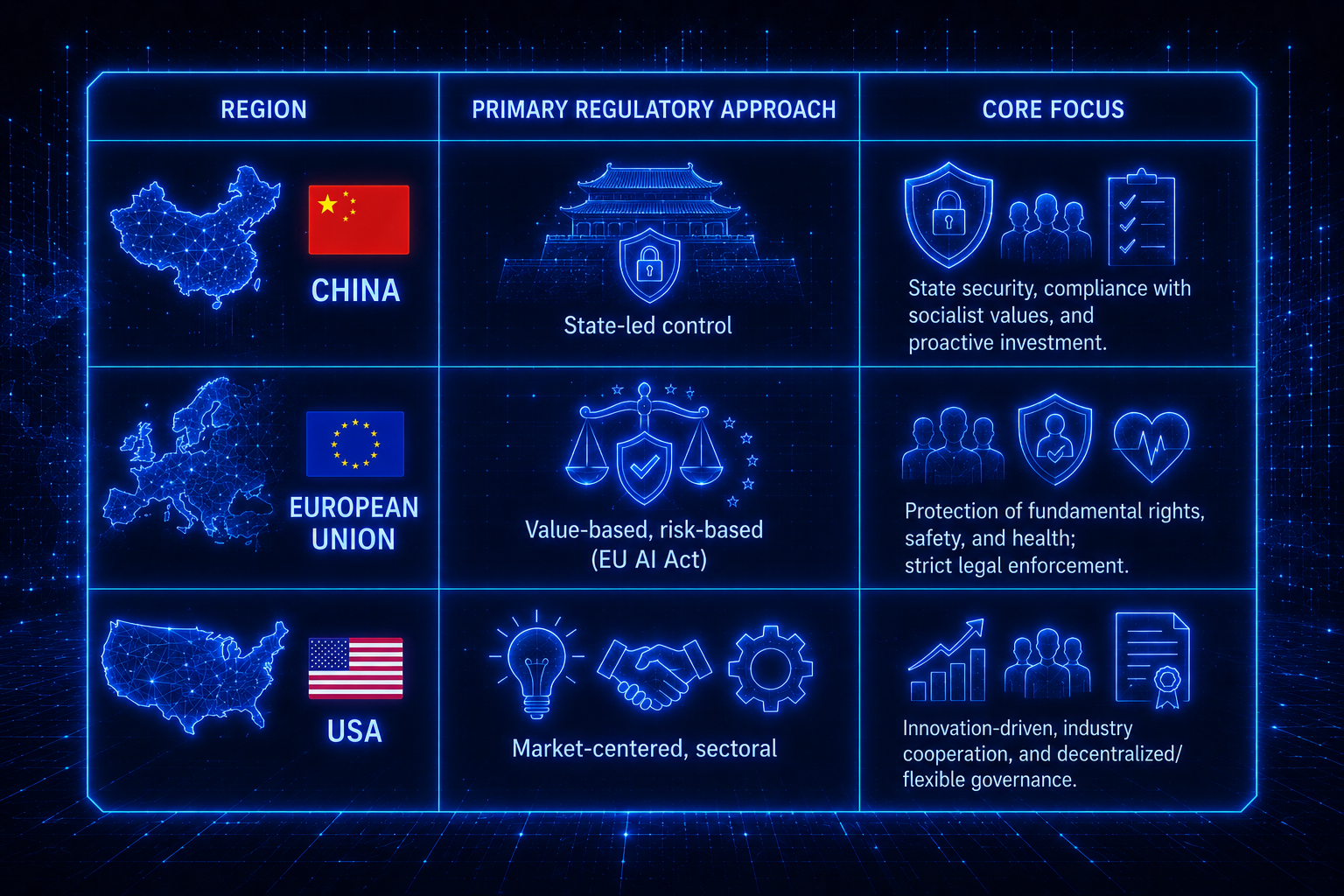
The following table illustrates China’s position relative to other global powers, highlighting the "competing models" of AI governance.
| Region | Primary Regulatory Approach | Core Focus |
|---|---|---|
| China | State-led control | State security, compliance with socialist values, and proactive investment. |
| European Union | Value-based, risk-based (EU AI Act) | Protection of fundamental rights, safety, and health; strict legal enforcement. |
| USA | Market-centered, sectoral | Innovation-driven, industry cooperation, and decentralized/flexible governance. |
While international forums such as the UN and OECD attempt to establish "minimal ethical minimums" across these diverse systems, China remains committed to a model where technological development is inextricably linked to state-defined security and ideological boundaries.
5. Key Perspectives and Definitions
The source context provides specific insights into the terminology and principles guiding this region:
- "China keeps technological development under close state and national security control."
- "Generative AI models... must reflect 'socialist core values,' and it is forbidden to produce content that subverts state power or the system."
Summary of Compliance for Businesses
For entities operating within or interacting with the Chinese AI market, compliance involves:
- Algorithmic Transparency: Mandatory registration of algorithms with the CAC.
- Content Filtering: Ensuring outputs do not conflict with state-mandated values.
- Human Input Documentation: For intellectual property claims, maintaining records of human selection and input is critical to securing copyright protection for AI-assisted outputs.