
Global AI Regulation in 2026: Who sets the rules?
Artificial intelligence is advancing faster than the legal systems designed to govern it. What was once a policy discussion is now a practical business challenge. In 2026, AI regulation directly affects how companies design products, use data, and expand into new markets.

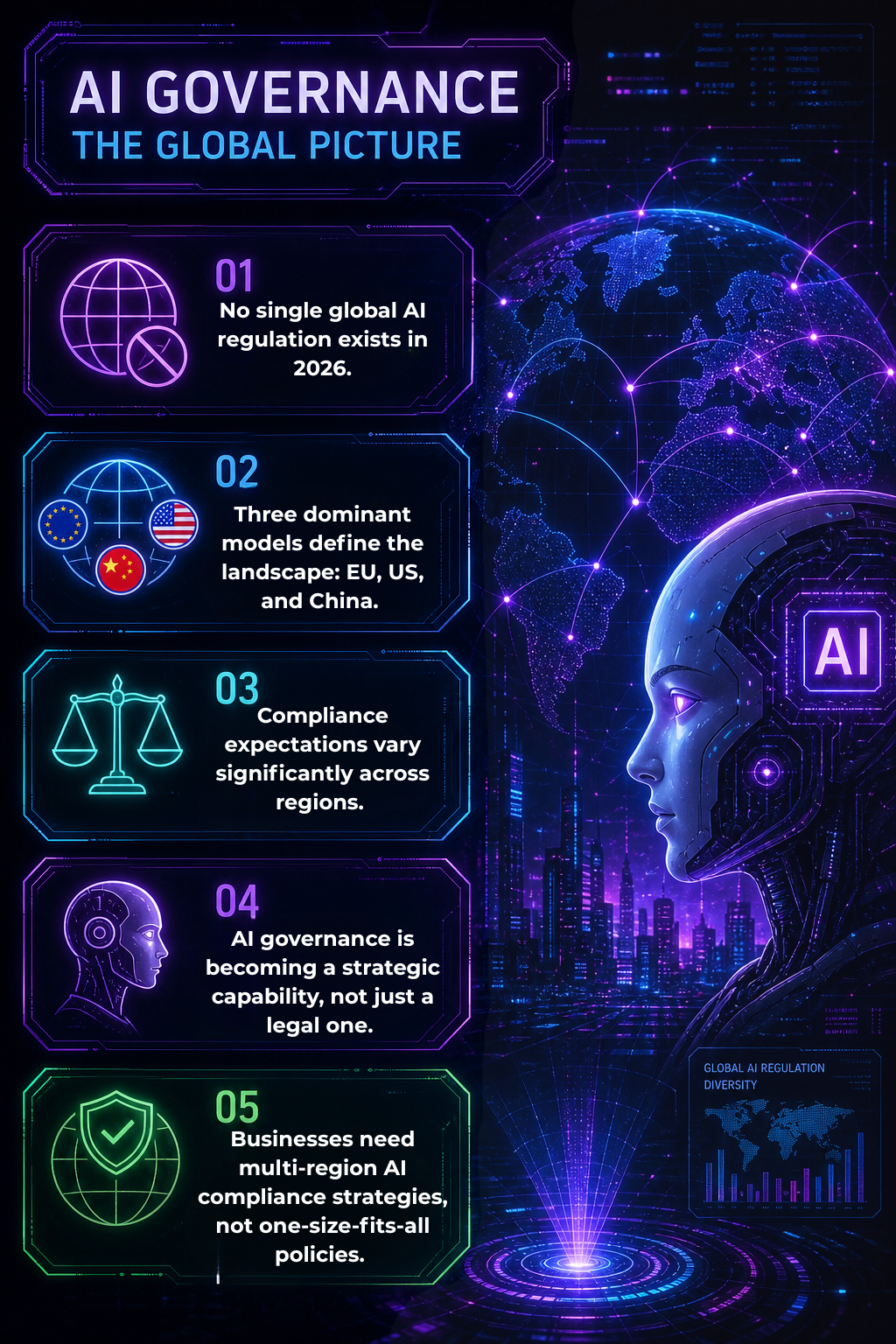
The real complexity, however, is not just the pace of regulation. It is the fact that different parts of the world are taking fundamentally different approaches. There is no single global standard. Instead, a fragmented system is emerging, shaped by a few dominant regulatory models.
For companies operating internationally, understanding these models is becoming essential.
What is AI regulation?
AI regulation refers to the rules and frameworks that govern how artificial intelligence systems are built, deployed, and monitored. It covers areas such as data usage, transparency, accountability, and risk management.
In practice, this means regulation now influences:
- how AI systems are designed
- what data they can use
- how decisions are explained
- and where they can be deployed
As AI becomes more embedded in business operations, regulation is moving from general principles to enforceable requirements.
A global shift — but no global alignment
Across regions, one clear trend is emerging: governments are increasing oversight of AI. Concerns around bias, misinformation, privacy, and security are pushing regulation forward at an accelerating pace. Yet while the direction is broadly shared, the implementation is not. Different countries are building their own frameworks based on local priorities. Some emphasize user protection and transparency, others prioritize innovation, while some focus more heavily on control and national security.
The result is a fragmented global landscape where the same AI system may be treated very differently depending on where it operates. In one market it may be considered low-risk and widely deployable, while in another it may face strict requirements or even restrictions. This divergence is not a temporary phase. It is becoming a defining feature of global AI governance, shaping how technology is developed and deployed across borders.
The three models shaping AI regulation
Europe: regulation and trust
Europe is leading with a comprehensive, risk-based approach that places strong emphasis on safety, transparency, and fundamental rights. Under this model, AI systems are classified according to their level of risk, and stricter obligations apply to those considered high-risk. This creates a structured and predictable framework, but also one where compliance must be built into systems from the very beginning.
(A detailed breakdown of the European approach is covered in a separate article.)
United States: flexibility and innovation
The United States, by contrast, has taken a more flexible and decentralized path. Rather than introducing a single, unified AI law, regulation is spread across sectors and agencies, with a strong focus on supporting innovation. This approach allows companies to move quickly and experiment, but it can also result in varying requirements across industries and jurisdictions, making the overall system less consistent.
(We explore how AI regulation works in the US in more detail in a dedicated article.)
China: control and security
China represents a third, distinct model, one that is built around strong state oversight and a focus on security and control. AI development is actively encouraged, but within a tightly regulated environment where content governance, monitoring, and alignment with national priorities play a central role. In this context, compliance extends beyond technical standards and into broader operational and regulatory alignment.
(A full analysis of China’s approach is available in a separate article.)

Beyond the big three
Beyond these three major approaches, many other countries are developing their own frameworks, often combining elements from multiple models. Some lean toward risk-based structures similar to Europe, while others adopt more flexible or innovation-driven policies. What unites them is a growing recognition that AI requires structured governance, even if the form that governance takes differs from one region to another.
Taken together, these developments point to a clear conclusion: global AI regulation is not converging toward a single system, but evolving into a network of distinct, sometimes overlapping frameworks. Understanding this landscape is no longer just about tracking policy changes. It is about recognizing how different regulatory philosophies shape the way AI can be built, deployed, and scaled around the world.
In 2026, the question is no longer whether AI will be regulated, but how — and by whom.
