
EU AI Act Explained: What Businesses Need to Know in 2026
The EU AI Act is the European Union’s landmark regulation for artificial intelligence, designed to govern how AI systems are developed, placed on the market, and used across the EU.

Quick Summary
It applies not only to EU-based companies, but also to businesses outside Europe if their AI systems affect people in the EU.
"The first broad legal framework that treats AI as a regulated technology."
What is the EU AI Act?
The EU AI Act is the European Union’s landmark regulation for artificial intelligence, designed to govern how AI systems are developed, placed on the market, and used across the EU. It applies not only to EU-based companies, but also to businesses outside Europe if their AI systems affect people in the EU.
In simple terms, it is the first broad legal framework that treats AI as a regulated technology rather than just a product or a software feature. That makes it one of the most important pieces of AI regulation in Europe today.
The EU’s risk-based AI model
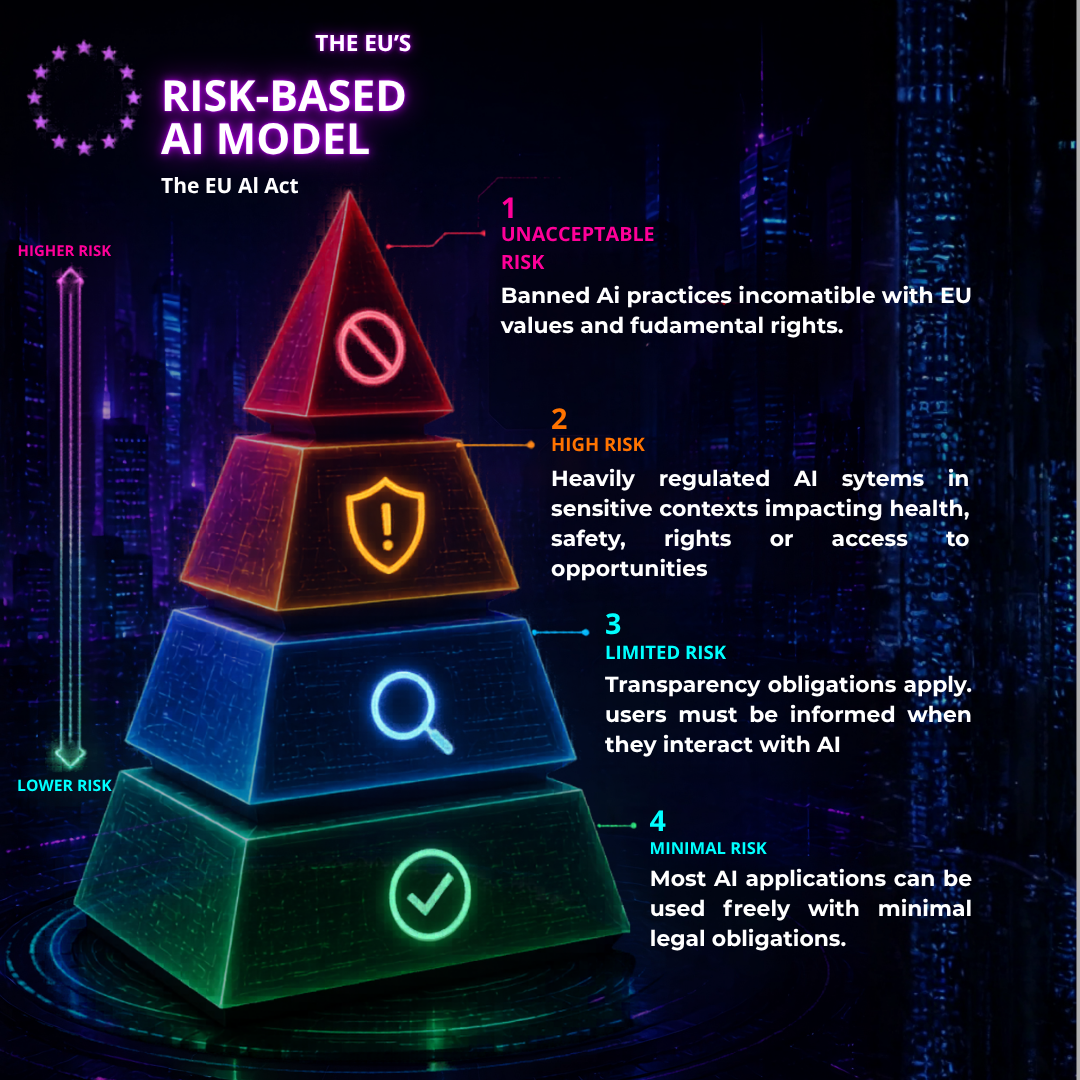
The core idea behind the EU AI Act is risk-based regulation. The law does not treat all AI systems the same way; instead, it matches the level of legal obligation to the level of potential harm. This is why the EU is not just regulating AI — it is defining what trustworthy AI looks like.
Unacceptable risk
These are AI practices that are banned because they are considered incompatible with EU values and fundamental rights. Typical examples include social scoring, manipulative AI that distorts human behavior, and certain types of real-time biometric identification in public spaces.
High-risk
High-risk AI systems are the most heavily regulated category. They are used in sensitive contexts where mistakes can affect health, safety, rights, or access to opportunities, such as hiring, healthcare, education, critical infrastructure, and law enforcement.
Limited risk
Limited-risk systems are not banned, but they must meet transparency obligations. Chatbots, deepfakes, and certain emotion-recognition or synthetic-media tools generally fall into this category, which means users must be clearly informed when they are interacting with AI.
Minimal risk
Most AI applications fall into the minimal-risk category. These systems can usually be used freely, with only limited legal obligations, although companies are still encouraged to follow responsible AI practices voluntarily.
High-risk AI systems
High-risk AI systems are the most important category for businesses to understand because they trigger the strongest compliance obligations. Under the EU AI Act, a system may be considered high-risk either because it is used as a safety component of a regulated product or because it is used in a high-impact area listed in the law.
Common examples include:
- Hiring and recruitment systems.
- Healthcare and medical AI.
- Education and exam or admission tools.
- Critical infrastructure and safety-related systems.
This category is critical because it is where AI can influence access to jobs, services, and rights. In other words, high-risk AI is where business innovation and legal responsibility meet most directly.
EU AI Act requirements for companies
Companies deploying or developing high-risk AI systems need to prepare for several core obligations. These are not just technical requirements; they are governance requirements that affect the entire product lifecycle.
Key requirements include:
- Risk management: companies must identify, assess, and reduce risks throughout the system’s lifecycle.
- Data quality: training, validation, and testing data must be relevant, representative, and carefully governed.
- Technical documentation: organizations must maintain clear records of how the AI system works and how it is controlled.
- Human oversight: people must be able to monitor, intervene in, or override the system when necessary.
- Transparency: users and operators must receive the information they need to understand how the AI behaves and what limits it has.
For businesses, this means compliance starts much earlier than deployment. It must be built into design, procurement, testing, and governance processes from the beginning.

What is banned?
The EU AI Act also prohibits a set of AI practices that the EU considers especially dangerous. These restrictions are among the clearest signs that the law is not only about control, but about protecting democratic and social values.
Examples of banned or tightly restricted practices include:
- Social scoring by public authorities.
- Manipulative or deceptive AI that materially distorts behavior.
- Certain forms of biometric surveillance in public spaces.
- Other AI uses that exploit vulnerability or undermine fundamental rights.
This is one of the sharpest distinctions between the EU model and more permissive regulatory systems. The EU is drawing a line around use cases it considers unacceptable, even if they may be technically feasible or commercially attractive.
Why the EU model matters globally
The EU AI Act is likely to influence AI regulation far beyond Europe. Because the EU is a major market, companies that want access to European customers often need to adapt their systems globally rather than only within the EU. This is the classic Brussels effect in action.
That makes the EU more than just a regulator. It is becoming a global standard setter. Many international companies will design their AI governance around EU expectations because it is easier to build one trustworthy system than to maintain separate versions for each market.
What it means for businesses
For businesses, the practical message is clear: compliance by design is no longer optional. Product teams, legal teams, data teams, and leadership all need to understand whether an AI system could be classified as high-risk, limited-risk, or prohibited under the EU framework.
The EU AI Act will influence product strategy, vendor selection, documentation, and market access decisions. The EU AI Act is not just a regulation — it is a blueprint for governing AI at scale.
"The EU AI Act is not just a regulation — it is a blueprint for governing AI at scale."
Conclusion
The EU AI Act is the most important AI regulation in Europe and one of the most influential technology laws in the world. By combining a risk-based structure with strong rights protections and compliance obligations, it sets a new benchmark for trustworthy AI.
For companies, the lesson is simple: if you build AI for Europe, you need to build governance into the system itself. The EU AI Act is not just a regulation — it is a blueprint for governing AI at scale.
